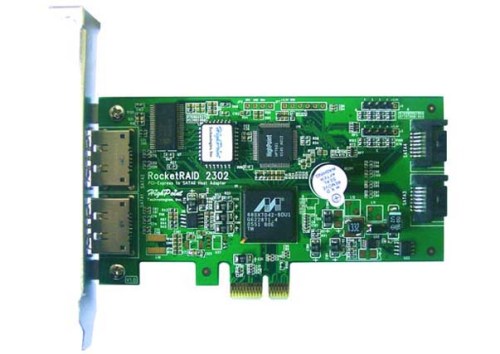
Backward compatible to RocketRAID 1640 RAID arrays
Support Windows (XP, 2000, Server 2003, Vista), Linux, Mac OS X and FreeBSD
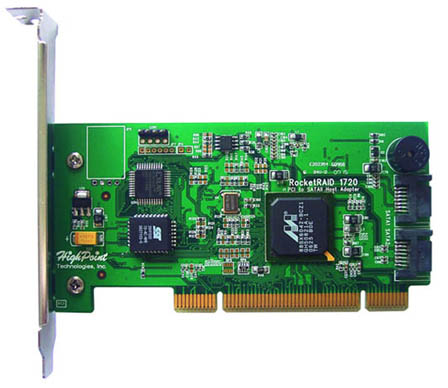
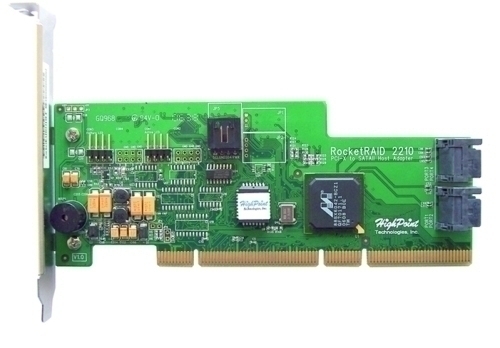
RocketRAID 1720 Host Adapter
The
RocketRAID 1720 is the cost effective choice for the upgrade market.
Desktop and workstations can realize the benefits of SATA II
technologies and utilize enterprise level
features that are unavailable with other embedded desktop solutions.
The RocketRAID 1720 offers RAID 1 for data protection and ensures that
the operating systems is always up and available in the event of a disk
failure. For gamers and pc enthusiast, the RocketRAID 1720 offers RAID
0 for performance. READ / WRITE activities will greatly increase
ensuring enjoyable game play with today’s feature rich and system
intensive gaming software.
Controller Specifications
PCI 32bit@33/66 Mhz
2 Internal SATA II ports
Up to 2 SATA II or SATA I Hard Drives
Support RAID 0, 1, and JBOD
Backward compatible to RocketRAID 1640 RAID arrays
Native Command Queuing (NCQ)
Online Capacity Expansion (OCE) and Online RAID Level Migration (ORLM)
Staggered drive spin up
Hard Disk (Activity / Failed) LED chassis function
BIOS Booting (INT13) to RAID array
Quick and Background initialization for instant RAID access
Hot swap and hot spare
Online array roaming
Automatic detect drive to rebuild degraded RAID
S.M.A.R.T array monitoring for hard drive status and reliability
64bit LBA for RAID arrays up to 2TB single partition
Web browser-base software (Web GUI)
Command Line Interface (CLI)
SMTP email notification for events and error reporting
Remote array management through (Web GUI, RAID GUI and CLI)
Support Windows (XP, 2000, Server 2003, Vista), Linux, Mac OS X and FreeBSD
RoHS Compliant
RAID Management Utilities
BIOS
Web based RAID
Management Software and CLI
Operating Systems
Support Windows (XP, 2000, Server 2003, Vista), Linux, Mac OS X and FreeBSD
STT
Nhà cung cấp
Liên hệ
Tiền/Mua
1
Công Ty TNHH Siêu Siêu Nhỏ
Địa chỉ chính: 254A Nguyễn Đình Chiểu - phường 6 - Quận 3 - Tp.Hồ Chí Minh Địa chỉ 1: 57 Láng Hạ - Thành Công Tower P. 1002, Ba Đình, HN
0 VNĐ
RocketRAID 1720 Highlights
PCI 32bit@33/66 Mhz
2 Internal SATA II ports
Up to 2 SATA II or SATA I Hard Drives
Support RAID 0, 1, and JBOD
Backward compatible to RocketRAID 1640 RAID arrays
Support Windows (XP, 2000, Server 2003, Vista), Linux, Mac OS X and FreeBSD
RocketRAID 1720 Host Adapter
The
RocketRAID 1720 is the cost effective choice for the upgrade market.
Desktop and workstations can realize the benefits of SATA II
technologies and utilize enterprise level
features that are unavailable with other embedded desktop solutions.
The RocketRAID 1720 offers RAID 1 for data protection and ensures that
the operating systems is always up and available in the event of a disk
failure. For gamers and pc enthusiast, the RocketRAID 1720 offers RAID
0 for performance. READ / WRITE activities will greatly increase
ensuring enjoyable game play with today’s feature rich and system
intensive gaming software.
Controller Specifications
PCI 32bit@33/66 Mhz
2 Internal SATA II ports
Up to 2 SATA II or SATA I Hard Drives
Support RAID 0, 1, and JBOD
Backward compatible to RocketRAID 1640 RAID arrays
Native Command Queuing (NCQ)
Online Capacity Expansion (OCE) and Online RAID Level Migration (ORLM)
Staggered drive spin up
Hard Disk (Activity / Failed) LED chassis function
BIOS Booting (INT13) to RAID array
Quick and Background initialization for instant RAID access
Hot swap and hot spare
Online array roaming
Automatic detect drive to rebuild degraded RAID
S.M.A.R.T array monitoring for hard drive status and reliability
64bit LBA for RAID arrays up to 2TB single partition
Web browser-base software (Web GUI)
Command Line Interface (CLI)
SMTP email notification for events and error reporting
Remote array management through (Web GUI, RAID GUI and CLI)
Support Windows (XP, 2000, Server 2003, Vista), Linux, Mac OS X and FreeBSD
RoHS Compliant
RAID Management Utilities
BIOS
Web based RAID
Management Software and CLI
Operating Systems
Support Windows (XP, 2000, Server 2003, Vista), Linux, Mac OS X and FreeBSD